

Find your
belt size.
Start with your waist / stomach measurement. Follow the steps, then find the size for your belt style.

Your waist / stomach.
At belly-button height.
Use a flexible tape measure around the part of your body where the belt will sit. Your trouser size is not the measurement to use.
-
Put the tape in position.
Wrap it around your waist / stomach at belly-button height. Measure over the clothing you normally train in, and keep the tape level all the way around.
-
Stand naturally. Stay relaxed.
Keep the tape snug without digging in. Do not suck your stomach in or pull the tape as tight as it will go.
-
Read it. Check it once more.
Record the measurement in inches or centimetres. Repeat the measurement, then choose your range in the size finder below.
One measurement.
Three belt styles.
Sizes differ between weightlifting, lever and prong belts. Choose your measurement range to see the recommendation for each.
Use your measurement at belly-button height. Ranges overlap: if your measurement fits ranges with different recommendations, get fit advice before ordering.
Choose a range above to see your recommended sizes.

Weightlifting Belt
—Lever Powerlifting Belt
—Prong Powerlifting Belt
—Check that the size is available on your chosen product. Between recommendations or seeing “Ask us”? Send us your measurement and belt choice.
View the full size chart
| Body measurement | Weightlifting Belt | Lever Powerlifting Belt | Prong Powerlifting Belt |
|---|---|---|---|
| 20–22 in50.8–55.9 cm | S | S | S |
| 21–23 in53.3–58.4 cm | S | S | S |
| 22–24 in55.9–61.0 cm | S | S | S |
| 23–25 in58.4–63.5 cm | S | S | S |
| 24–26 in61.0–66.0 cm | S | S | S |
| 25–27 in63.5–68.6 cm | S | S | M |
| 26–28 in66.0–71.1 cm | S | S | M |
| 27–29 in68.6–73.7 cm | S | S | M |
| 28–30 in71.1–76.2 cm | M | S | M |
| 29–31 in73.7–78.7 cm | M | M | M |
| 30–32 in76.2–81.3 cm | M | M | L |
| 31–33 in78.7–83.8 cm | M | M | L |
| 32–34 in81.3–86.4 cm | M | M | L |
| 33–35 in83.8–88.9 cm | L | M | L |
| 34–36 in86.4–91.4 cm | L | M | XL |
| 35–37 in88.9–94.0 cm | L | L | XL |
| 36–38 in91.4–96.5 cm | L | L | XL |
| 37–39 in94.0–99.1 cm | XL | L | XL |
| 38–40 in96.5–101.6 cm | XL | L | 2XL |
| 39–41 in99.1–104.1 cm | XL | XL | 2XL |
| 40–42 in101.6–106.7 cm | 2XL | XL | 2XL |
| 41–43 in104.1–109.2 cm | 2XL | XL | 2XL |
| 42–44 in106.7–111.8 cm | 3XL | XL | 3XL |
| 43–45 in109.2–114.3 cm | 3XL | 2XL | 3XL |
| 44–46 in111.8–116.8 cm | 4XL | 2XL | 3XL |
| 45–47 in114.3–119.4 cm | 4XL | 2XL | 3XL |
| 46–48 in116.8–121.9 cm | 5XL | 2XL | 4XL |
| 47–49 in119.4–124.5 cm | 5XL | 3XL | 4XL |
| 48–50 in121.9–127.0 cm | 6XL | 3XL | 4XL |
| 49–51 in124.5–129.5 cm | 6XL | 3XL | 4XL |
| 50–52 in127.0–132.1 cm | 7XL | 3XL | 5XL |
| 51–53 in129.5–134.6 cm | 7XL | 4XL | 5XL |
| 52–54 in132.1–137.2 cm | 7XL | 4XL | 5XL |
| 53–55 in134.6–139.7 cm | 7XL | 4XL | 5XL |
| 54–56 in137.2–142.2 cm | 10XL | 4XL | 6XL |
| 55–57 in139.7–144.8 cm | 10XL | 5XL | 6XL |
| 56–58 in142.2–147.3 cm | 10XL | 5XL | 6XL |
| 57–59 in144.8–149.9 cm | 10XL | 5XL | 6XL |
| 58–60 in147.3–152.4 cm | 10XL | 5XL | 7XL |
| 59–61 in149.9–154.9 cm | Ask us | 6XL | 7XL |
| 60–62 in152.4–157.5 cm | Ask us | 6XL | 7XL |
| 61–63 in154.9–160.0 cm | Ask us | 6XL | 7XL |
| 62–64 in157.5–162.6 cm | Ask us | 6XL | 8XL |
| 63–65 in160.0–165.1 cm | Ask us | 7XL | 8XL |
| 64–66 in162.6–167.6 cm | Ask us | 7XL | 8XL |
| 65–67 in165.1–170.2 cm | Ask us | 7XL | 8XL |
This chart covers the leather belt styles shown below. For other products, use the size guide on the product page. “Ask us” means no size is listed in this chart for that range.
Which belt is yours?
The same size label can fit differently across belt styles. Use the column for the belt you are ordering.
Weightlifting Belt
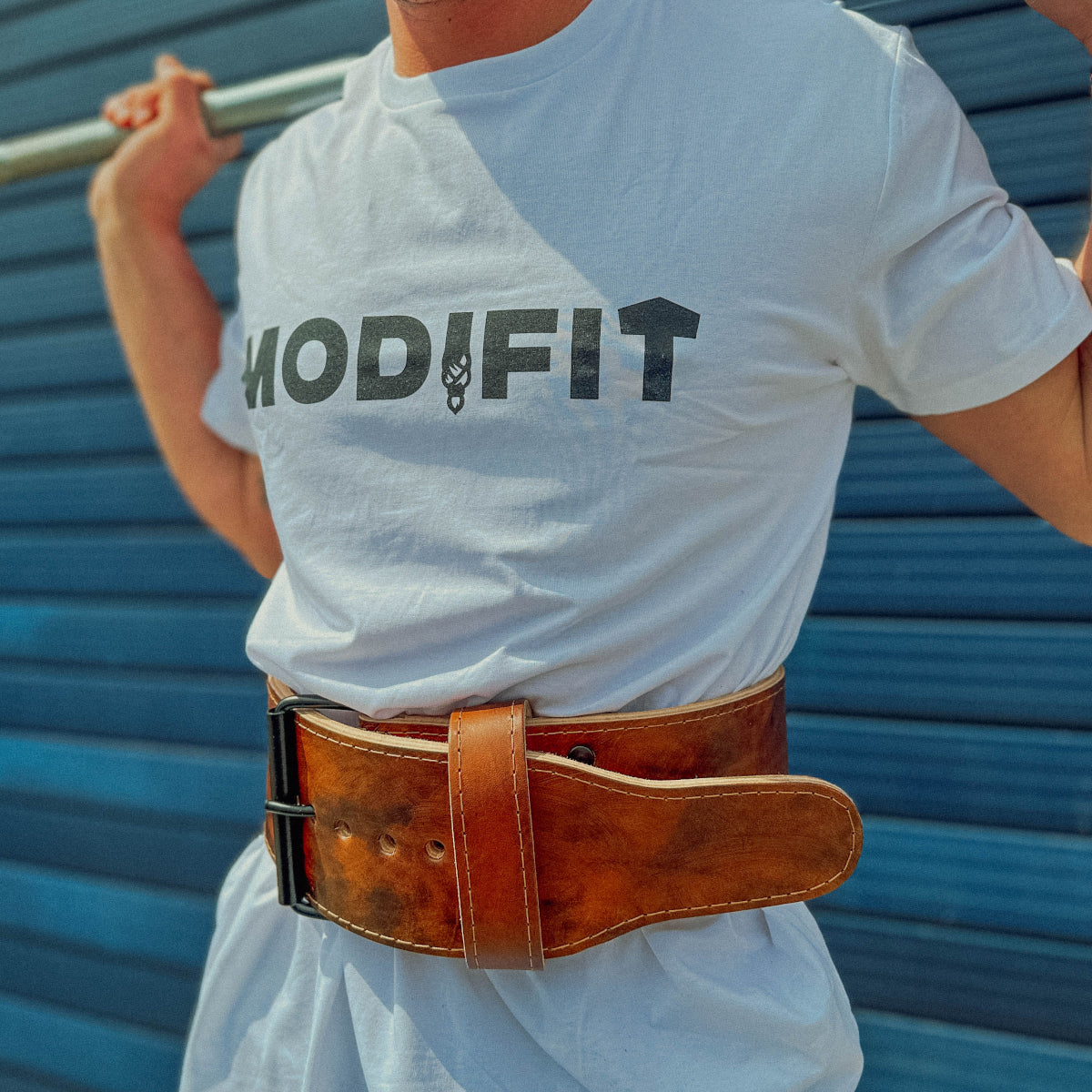
A shaped belt with a 4-inch back, tapering to around 2.5 inches at the front.
Lever Powerlifting Belt
An even-width belt with a lever fastening. Use the lever column for its sizing.
Prong Powerlifting Belt
An even-width belt, available in 3 or 4 inches, fastened with a prong buckle.
Snug.
With room to brace.
Try your belt over your normal training clothes. It should feel secure without being uncomfortably tight, and let you brace your abdomen against it.
Do not suck your stomach in and tighten the belt as much as possible. A good fit leaves you able to breathe and brace.
Why can’t I use my trouser size?
Trouser labels are not a direct measurement of your waist / stomach where a lifting belt sits. Measure your body with a tape at belly-button height.
What if I am between recommendations?
The chart has overlapping measurement ranges. If neighbouring ranges suggest different sizes, contact us with your measurement and the belt style you want before ordering.
Do all belt styles fit the same way?
No. For weightlifting and prong belts, the aim is to sit around the middle of the belt’s stated fitting range. For lever belts, the aim is nearer three-quarters through that range to reduce excess overlap. These are belt fitting ranges, not the two-inch body-measurement bands in the finder.
What if my size is not on the product page?
Contact us with your waist / stomach measurement and a link to the belt you want. We can check the available options before you place your order.
Still between sizes?
Send us your waist / stomach measurement and the belt you are considering. We will help you choose.